Nina the Nightingale’s Sleepy Symphony
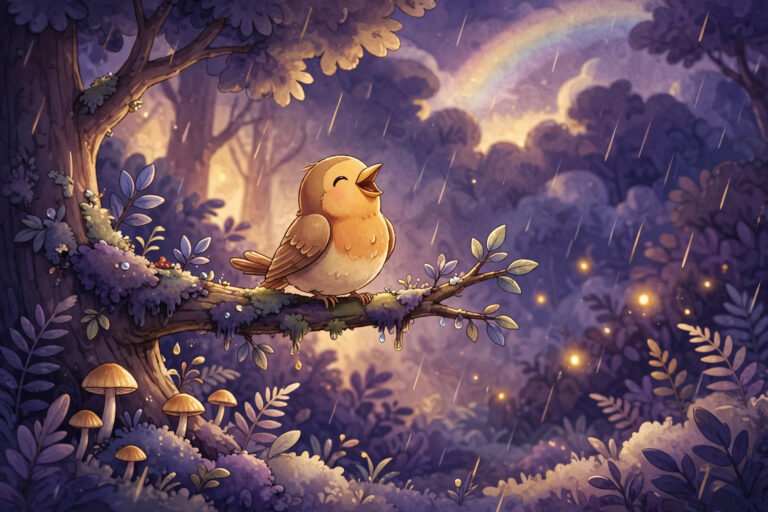
Nina the nightingale had the most beautiful voice in the whole forest. When she sang in the daytime — trill-ee-oh, trill-ee-oh! — the rabbits stopped hopping to listen, the bees stopped buzzing, and even the grumpy old badger tapped his foot.
“Bravo!” everyone would cheer. “Sing it again, Nina!”
And Nina would. She sang at sunrise and she sang at noon and she sang at teatime. She sang so much that her little throat got tired — but she didn’t care. Singing was her favorite thing in the world.
One evening, as the sky turned peachy-pink, Mama Nightingale said, “Time to quiet down, Nina. The forest is getting sleepy.”
But Nina had one more song bursting inside her. “Just ONE more!” she said, and she sang her biggest, loudest song yet — TRILL-EE-OH, TRILL-EE-OH, LAAA-LAAA-LAAA!
Down below, Benny the bunny covered his ears. “Too loud!” he squeaked. In the pond, Franny the frog frowned. “I’m TRYING to get sleepy!” And in the hollow tree, Ollie the owl blinked his big eyes. “Nina,” he hooted softly, “the night needs quiet music.”
Nina felt her cheeks go hot. “But… but singing is what I DO,” she said in a small voice. “If I can’t sing, what am I for?”
Ollie fluttered down beside her. “Who says you can’t sing?” he hooted. “The night has its OWN singing — you just have to sing it softly. Here. Listen.”
Nina listened. And slowly, she began to hear it — the night’s quiet music, playing all around her.
Hushhh, went the leaves in the evening breeze. Trickle-trickle, went the little stream. Hoo… hoo… went Ollie’s own soft call. It wasn’t loud like her daytime songs. It was gentle, like a blanket made of sound.
“Oh,” breathed Nina. “It’s a symphony. A SLEEPY symphony.”
“Exactly,” smiled Ollie. “And every symphony needs someone to lead it. Will you be our conductor tonight?”
Nina’s heart fluttered with excitement. She lifted one tiny wing like a conductor’s baton.
“Leaves,” she whispered, “your turn.” Hushhh, sang the leaves. “Stream, join in.” Trickle-trickle, sang the stream. “Ollie…” Hoo… hoo…
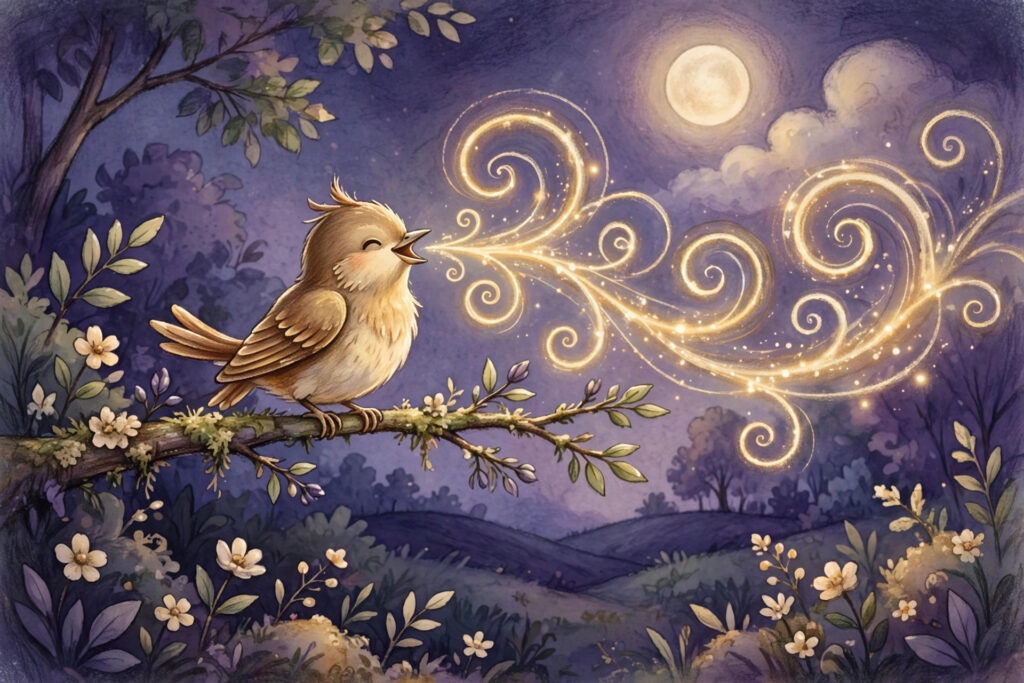
And then Nina added her own voice — not loud, not showy, but soft as moonlight: loo-loo-loo, loo-loo-loo… a sweet, sleepy thread weaving through all the night sounds.
Down below, Benny the bunny uncurled his ears and smiled in his sleep. Franny the frog sighed happily — ribbet — and drifted off. One by one, every animal in the forest closed their eyes, wrapped in Nina’s sleepy symphony.
Last of all, Nina felt her own eyelids growing heavy. She gave one final tiny wave of her wing… and the leaves hushed… and the stream trickled… and Nina the nightingale — the loudest singer in the forest — fell asleep to the softest music of all.
Loo… loo… loo…
The end.
Read It Aloud Like a Pro
- Sing loud, then sing soft. Nina’s daytime songs should ring out — don’t be shy! But her sleepy symphony must be genuinely soft. The volume journey is the whole lesson; make it dramatic.
- Give every night sound its own voice. The leaves (hushhh), the stream (trickle-trickle), Ollie’s hoo… hoo… — make each one distinct. Your child will start “hearing” the forest.
- Conduct together. When Nina lifts her wing, lift your hand too, and let your child conduct. Wave slowly for soft sounds, freeze for silence. It’s magical.
- Pause for the listening moment. When Ollie says “Here. Listen,” actually stop reading for five seconds. Let the real room sounds fill the quiet — then continue. The pause teaches listening better than any words.
- Fade the finale. The last loo… loo… loo… should get softer with each one until it’s barely a breath. Then close the story in silence.
Talk About It
- “Why did Nina feel sad when the animals covered their ears?” Listen for empathy — she realized her loud song was hurting her friends’ sleepy feelings, not just being ignored.
- “Was the sleepy symphony worse than her daytime songs, or just different?” You’re reinforcing that soft and gentle has its own beauty — a useful idea far beyond music.
- “What sounds did Nina hear in the night?” Leaves, stream, owl. Then ask: “What night sounds can YOU hear right now?” — listening practice disguised as conversation.
- “Why do you think soft music helps us fall asleep?” Guide them to notice how their own body feels with loud vs. soft sounds — early self-awareness.
- “If YOU were the conductor, which sounds would you pick?” Let them build their own sleepy symphony from bedroom sounds — rain, breathing, a ticking clock. Write their picks down and conduct it together tomorrow night.
- “How do you think Nina felt when everyone fell asleep to her music?” Proud, peaceful, and part of something bigger — help your child name that warm feeling of helping others rest.
New Words to Grow On
- Symphony — many sounds playing together like one big song. Tomorrow: “Let’s make a breakfast symphony!” (spoon clinks, toast pops, giggles).
- Soothe — to make someone feel calm and better. Tomorrow: “This warm milk will soothe you,” or ask what soothes them.
- Hush — a soft “shhh” sound. Tomorrow: practice saying “hush” in the softest voice possible.
- Melody — a tune you can sing or hum. Tomorrow: make up a silly-morning melody together.
- Conduct — to lead musicians, waving like Nina’s wing. Tomorrow: take turns conducting each other’s humming.
- Lullaby — a soft song to help someone sleep. Tomorrow: ask grandparents what lullaby they remember.
Tonight’s Little Ritual
The Sleepy Symphony (5 minutes). Be Nina the conductor: lie in bed and “conduct” four rounds of night sounds. Round 1 — everyone hums one soft note together, holding it as long as you can. Round 2 — whisper hushhh like leaves, three times, softer each time. Round 3 — click tongues softly like the trickling stream, then let it fade. Round 4 — one long loo… loo… loo… that gets quieter each time until it disappears into the dark. Then fold your conductor’s wing (hand) onto the blanket and smile. Symphony over — sleep begins.