Pip the Penguin Learns to Share
Read-aloud tip for parents: let your little one hold a few small “pebbles” (cushions work!) and hand them out as Pip shares.
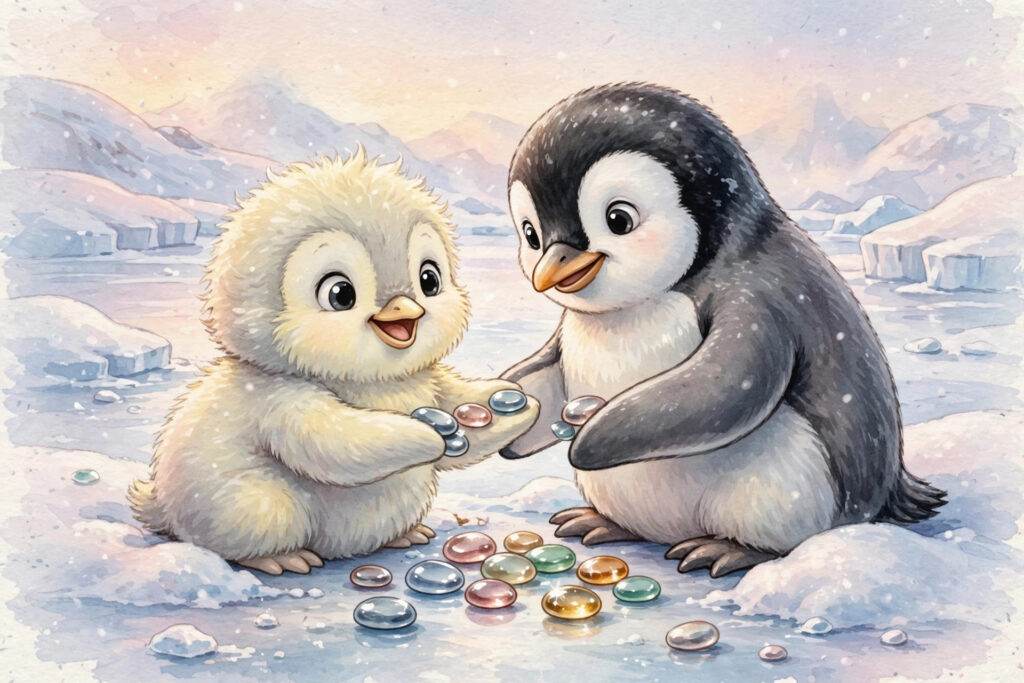
On the sparkling white ice of the South Pole lived a little penguin named Pip.
Pip had the finest collection of shiny pebbles in the whole colony. Smooth ones. Speckly ones. One that glittered like a star when the sun hit it just right.
Pip loved his pebbles. He polished them every morning. He lined them up every evening. And he shared them with…
Nobody.
“Mine,” Pip would say, flippers wrapped tight around his treasure, whenever anyone came near.
One frosty morning, his friend Willa waddled over. “Pip! I found the smoothest sliding hill! Want to race pebbles down it with me?”
Pip clutched his pebbles tighter. “You don’t have any pebbles,” he said.
“I know,” said Willa sadly. “That’s why I asked.”
Pip looked at his glittering collection. Then he looked at Willa’s hopeful face. Slowly — very slowly — he picked out his second-shiniest pebble and held it out.
“Just for the race,” he mumbled.
Willa’s eyes lit up like the aurora. “Really?!”
They raced pebbles down the hill all morning. Pip’s star-pebble won twice! Willa’s pebble won three times! They laughed so hard they fell over in the snow, and Pip discovered something surprising:
Racing alone was fun. Racing together was much more fun.
That evening, Pip did something he’d never done before. He picked out three more pebbles — a smooth one, a speckly one, and yes, even the star one — and waddled to Willa’s igloo.
“For keeps,” he said, a little shyly.
Willa hugged him so tight his feathers fluffed up. “Best friends share,” she said.
And from that day on, Pip the Penguin still loved his shiny pebbles. But he loved something even more:
Sharing them.
The end. Goodnight, kind one.
—
For parents: Sharing is a skill, not a trait — toddlers learn it by watching and practicing. Narrate your own sharing during the day (“I’m sharing my apple with you!”) and praise every small share you see. More gentle lessons in our bedtime stories collection.
Read It Aloud Like a Pro
Pip’s story turns on one brave moment — the slow sharing of the pebble. Give that moment room, and the lesson lands on its own.
- Give Pip a proud little voice for “Mine!” Wrap your own arms tight around yourself like flippers clutching treasure, and let your child copy the pose. They will feel exactly how Pip feels.
- Make Willa sound warm and hopeful. Her cheer against Pip’s clutching is the whole contrast of the story. When she says “That’s why I asked,” let a little sadness sit in it.
- Slow down at the turning point. Read “Slowly — very slowly — he picked out his second-shiniest pebble” at half speed. Let the slowness hang in the air. This is the bravest thing Pip does in the whole story.
- Race the pebbles with sound effects. Whoosh down the sliding hill! Let your child choose which pebble wins each race — Pip’s star-pebble, Willa’s pebble, back and forth. Falling-over laughter is mandatory.
- Land the last line softly. Say Willa’s “Best friends share” the way you would say it as a hug — soft and sure. Then give your child an actual hug. The story earns it.
Talk About It
Sharing is one of the hardest lessons for little ones — and Pip learns it the honest way, slowly. Talk it through without lecturing.
- Why didn’t Pip want to share his pebbles? They were his treasure, and he loved them. Ask about something your child finds hard to share. No judgment here — just listen. Feeling understood comes before sharing.
- How did Willa feel when Pip said no? Sad — even though she stayed kind. Ask: how can you tell someone feels sad, even when they don’t cry? Reading faces is a skill, and this is how it grows.
- What finally changed Pip’s mind? He looked at Willa’s hopeful face — really looked. Ask what it means to notice someone else’s feelings. That noticing is where all kindness begins.
- Was racing together really more fun than racing alone? Pip discovered it was much more fun. Ask about a time playing with a friend felt better than playing alone. Let them convince themselves.
- At the end Pip gave pebbles “for keeps” — even the star one. What is the difference between lending something and giving it? Listen for their understanding of generosity. Then ask: is there something small you could give for keeps to someone you love?
New Words to Grow On
Six shiny words from Pip’s icy world. Line them up like pebbles and collect them one by one.
- Colony — a big family group of animals living together. “The finest collection in the whole colony.” Tomorrow: call your family your colony at breakfast and watch everyone grin.
- Glittered — sparkled with tiny flashes of light. “Glittered like a star.” Tomorrow: find three things in your home that glitter.
- Clutched — held very, very tightly. “Pip clutched his pebbles tighter.” Tomorrow: notice when you clutch something — and practice gently letting go.
- Aurora — colorful lights that dance across the polar sky. “Her eyes lit up like the aurora.” Tomorrow: look at a picture of the real aurora together and pick your favorite color.
- Shyly — a little nervous and quiet. “For keeps,” he said, a little shyly. Tomorrow: remember it is okay to feel shy when you are doing something brave.
- Waddle — to walk with short, wobbly steps. “Willa waddled over.” Tomorrow: waddle like a penguin all the way to the bathroom.
Tonight’s Little Ritual
The Pebble of Kindness — five gentle minutes to end the day with a giving heart.
- Each of you picks an imaginary pebble — smooth, speckly, or star. Hold it tight and feel how precious it is.
- Think of one kind thing you will do tomorrow. It can be tiny. Tiny counts.
- Now “give” your pebble to each other — open your hand and place it softly in the other’s palm, for keeps.
- Say one thing you are thankful your family shares with you — stories, hugs, warm pancakes, silly songs.
- Tuck your pebble under the pillow. It will be there in the morning, and so will the kind thing you planned.
Pip learned that shared joy is double joy. Tonight, your little one falls asleep holding a pebble of kindness — and tomorrow, they get to spend it.