Rhyming Words for Kids: 20 Fun Examples + a Silly Read-Aloud Story
Rhyming isn’t just fun — it’s brain-building. When children hear that cat and hat share a sound chunk, they’re learning to slice words into parts, the exact skill reading requires. The best part? Rhyme practice looks like pure silliness.
20 rhyming pairs to play with
Say each pair with big expression, and let your child guess the rhyme before you say it:
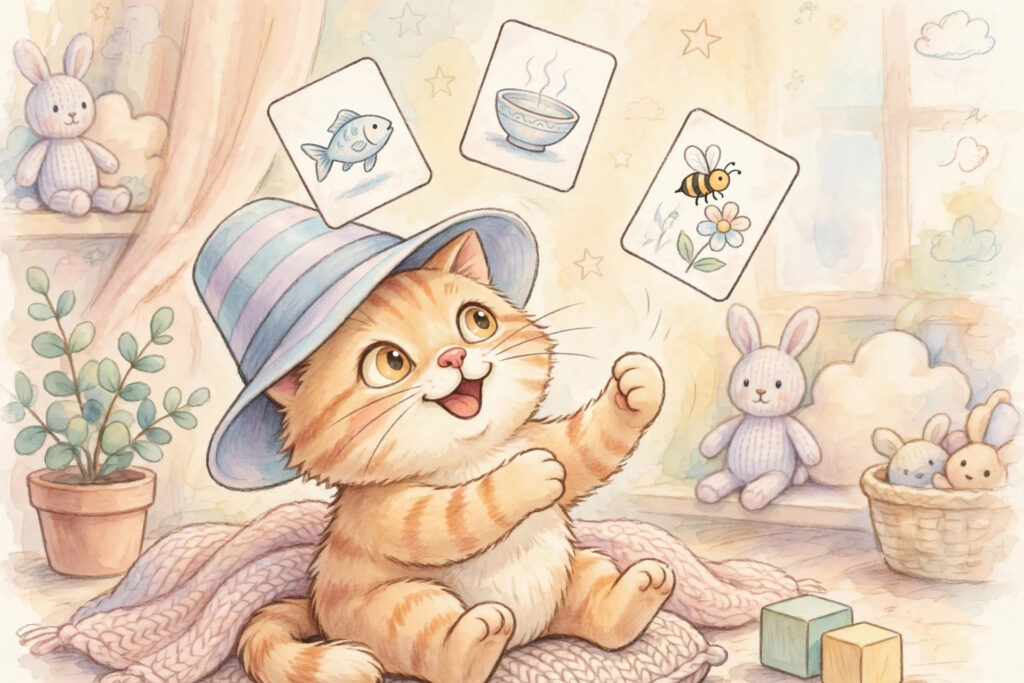
1. cat – hat
2. dog – frog
3. sun – fun
4. pig – wig
5. bee – tree
6. cake – snake
7. ball – tall
8. fish – dish
9. bear – chair
10. duck – truck
11. mouse – house
12. star – car
13. book – cook
14. rain – train
15. fox – box
16. bed – red
17. king – sing
18. boat – goat
19. egg – leg
20. night – light
Make it a game: say one word (“What rhymes with cat?”) and accept any answer — real or silly. “Bat! Hat! Splaaat!” Nonsense rhymes count double.
A silly rhyming story to read aloud
The Cat in the Hat Who Sat on a Mat (a very silly tale)
A cat in a hat sat on a mat,
With a bat and a rat and a flat gray… cat? (Wait — that’s him!)
He saw a big dog by a log,
With a frog on a bog, doing the… jog? (Frogs can’t jog. He hopped!)
They saw the sun having fun,
With a bun — a hot cross bun! — for everyone.
A pig in a wig did a jig,
So big, so grand, with a band in hand!
A bee in a tree, as happy as can be,
Shared honey tea with a flea… (a very small cup).
A cake with a snake? A mistake!
The snake said, “For goodness sake — just take the cake!”
A ball so tall hit the wall,
And down came the ball… to the hall!
They ate on a dish with a fish,
Who said, “Delish!” with a swish-swish-swish.
The bear in the chair shared a pear,
With flair, I declare, and nary a care!
A duck in a truck said, “What luck!”
As the truck got stuck in the muck. (Oh, duck.)
A mouse in a house chased a louse…
(No. Too itchy. Let’s say he chased his spouse. Much nicer.)
A star in a car drove far,
Past the moon and Mars — what a star!
A book for a cook who could cook by the brook,
Who read as he fried — what a multitasker!
The rain on the train went “pitter-pat!”
And the fox in the box said, “I like that!”
The king liked to sing — la la la LING!
(Don’t correct him. He’s the king.)
A boat with a goat stayed afloat,
Wearing a coat. (Safety first.)
An egg on a leg? Don’t beg!
Just put down the egg… and go to bed!
For now it’s night, so hold on tight,
And dream in the soft starlight.
The end — now YOU make up a rhyme!
—
For parents: After the story, take turns making up rhyming couplets about your day (“We ate some stew / and played with Blue!”). The sillier, the stickier. More sound play in our phonics games collection.
Try This Today
Rhyming practice works best in tiny bursts through the day. Here are four you can start today — no prep needed.
1. Rhyme Walk. Take a short walk and take turns rhyming things you pass. “Tree!” — “Bee!” “Car!” — “Star!” Keep it moving and silly; speed matters more than perfection. A five-minute walk can pack in twenty rhymes without anyone noticing they’re “learning.”
2. Silly Soup. Toss a few small toys or objects into a pot — a toy cat, a ball, a spoon. Stir with a wooden spoon, pull one out, and everyone shouts a rhyme. “Cat!” — “Hat! Bat! Splaaat!” Drop it back in and stir again. The randomness keeps kids hooked.
3. Bedtime Rhyme Chain. After lights-out (but before sleep), start a slow back-and-forth chain. You say “moon,” your child says “spoon,” you say “soon,” they say “balloon.” See how long the chain grows. It’s calming, cozy, and secretly excellent ear training.
4. Rhyme Echo Clap. Clap a simple rhythm — clap-clap-PAUSE — and chant rhyming pairs to the beat: “dog-frog, dog-frog!” Then let your child pick the next pair. Rhythm plus rhyme is a powerful memory combo, and wiggly kids love the beat.
Mistakes Most Parents Make
Mistake 1: Correcting nonsense rhymes. When your child shouts “splaaat!” for cat, it feels wrong to let it pass — but nonsense rhymes prove your child hears the sound pattern, which is the whole point. Do this instead: celebrate them. “Splaaat! That rhymes AND it’s hilarious!” Real words will come.
Mistake 2: Saving rhymes for “learning time.” A once-a-week rhyme session can’t compete with rhymes sprinkled through the day. Do this instead: drop rhymes into ordinary moments — in the car, while cooking, during bath time. Frequency beats formality.
Mistake 3: Expecting perfect rhymes immediately. Early attempts sound like “cat… car?” — close but not quite. Do this instead: accept near-rhymes warmly at first (“Ooh, those start the same! Now listen to the ending — cat… hat?”). The ear sharpens with play, not pressure.
Mistake 4: Going too long. Fifteen minutes of forced rhyming turns a game into a chore. Do this instead: stop after five happy minutes, while your child still wants more. Short and wanted beats long and endured.
Quick Answers
My child can’t hear rhymes yet. Is that normal? Yes. Hearing rhyme is a skill that develops with exposure, not a switch that flips. Some kids get it at three, others at five. Keep playing the games without any testing — the ear training is happening quietly in the background.
Should rhyming come before letters? It can — and often does. Little ones bounce to nursery rhymes long before they meet the alphabet. Rhyme play builds sound awareness, which later makes letter sounds easier to grasp. There’s no required order; follow what your child enjoys.
My child just repeats my rhyme instead of making their own. Is that okay? Absolutely — repetition is how learning starts. Echoing your rhyme means they’re hearing and producing the pattern. After a while, try pausing before the rhyme and letting them fill the gap: “The cat sat on the…” (wait, smile). They’ll jump in when ready.
Do rhymes actually help with reading? Rhyming trains children to hear the smaller sound chunks inside words — the same listening skill they’ll use to sound words out later. Think of it as ear exercise for future readers. And it’s fun, which means kids actually do it.
Your 7-Day Mini Plan
One tiny rhyme moment a day. That’s the whole plan.
- Day 1 — Rhyme Walk. Rhyme everything you see on a short walk.
- Day 2 — Silly Soup. Stir the pot and shout rhymes for each object.
- Day 3 — Bedtime Rhyme Chain. One slow chain before sleep.
- Day 4 — Rhyme Echo Clap. Chant rhyming pairs to a clapped beat.
- Day 5 — Rhyme hunt. Find three rhyming pairs in a picture book together.
- Day 6 — Make-up story. Take turns adding rhyming lines about your day.
- Day 7 — Rhyme show. Your child performs their favorite rhymes for the family.